Last updated
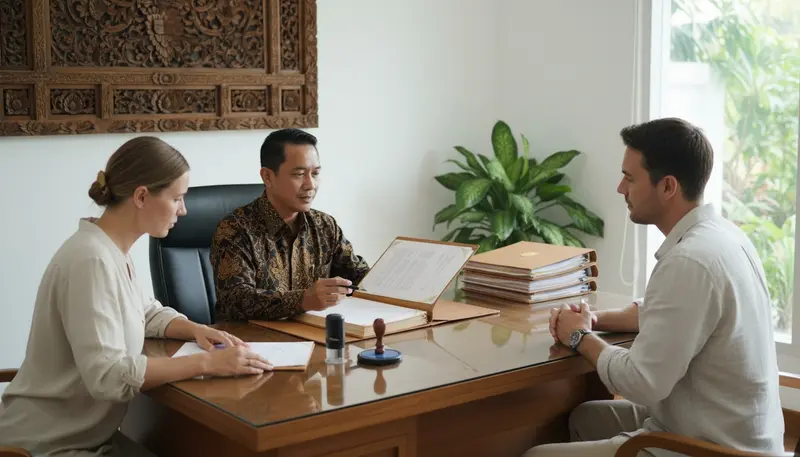
A PPAT (Pejabat Pembuat Akta Tanah) is the land deed official in Indonesia. In Bali, the PPAT drafts and registers the deeds that move or burden land rights: the sale deed (AJB), the grant or extension of HGB and Hak Pakai titles, mortgages, gifts and exchanges. Only a PPAT deed transfers land title. A private sale agreement binds the buyer and seller, but it moves nothing at the land office.
Fees: the PPAT fee is capped at 1% of the value up to Rp 500 million, 0.75% up to Rp 1 billion, 0.5% up to Rp 2.5 billion and 0.25% above that, witnesses included. See notary fees in Bali.
What does the PPAT do in a Bali property sale?
- Checks the certificate at BPN. A certified copy from the land office is compared with the seller's original and the land book, to catch forgeries, mortgages, court blocks and marital disputes.
- Reviews the zoning under the regional spatial plan.
- Drafts the deed in Indonesian, as the law requires, with an English version when a foreigner signs. The AJB lists the certificate number, the measurement letter (surat ukur), the land area, the parties, the price and the tax calculations.
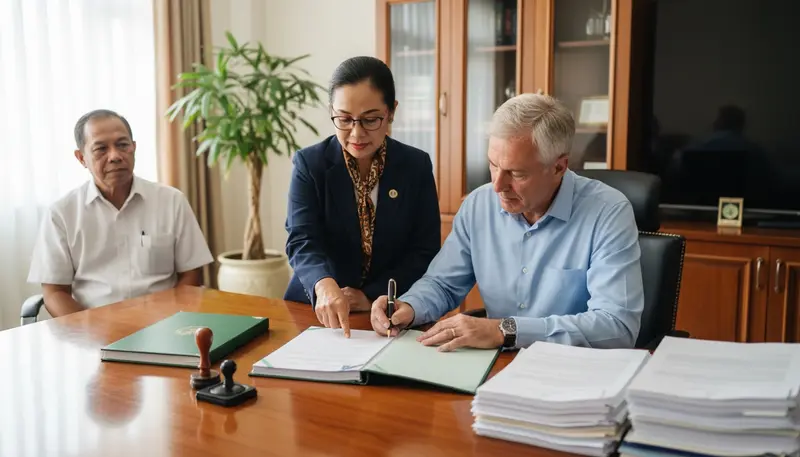
- Witnesses the signing. Buyer and seller sign in the PPAT's physical presence, or through a valid power of attorney.
- Collects the taxes. BPHTB of 5% of the value above the regional threshold from the buyer, and 2.5% final income tax from the seller, paid before the deed can be registered. Stamp duty is Rp 10,000 per document.
- Registers the transfer at BPN, which records it in the land book and issues the certificate in the buyer's name.
- Hands over the new certificate with the signed deeds and tax receipts.
How long does a Bali property transfer take?
| Stage | Timing |
|---|---|
| Reservation agreement and deposit | Day 0 |
| Due diligence: certificate, zoning, charges | Days 1 to 14 |
| Draft deed circulated | Days 14 to 21 |
| Signing and tax settlement | Days 21 to 28 |
| Registration at BPN | Days 28 to 56 |
| New certificate delivered | Days 56 to 70 |
Must the PPAT be licensed where the land is?
Every PPAT is appointed for a specific area, usually a regency or city. A Denpasar PPAT cannot draw a deed for land in Gianyar, and a deed drawn outside the appointment is rejected by the land office. Canggu, Seminyak, Kerobokan, Kuta, Jimbaran and Uluwatu sit under Badung's land office; Ubud under Gianyar's. The principals of this office hold both the notary and the PPAT appointment.
What will the PPAT not do?
The PPAT is neutral. It acts for the transaction, not for the buyer, and does not judge whether the price is fair or the seller has told you everything. That is property due diligence and contract review, done before the signing day. A PPAT also refuses to draft a nominee deed, record a false price or draw an irrevocable power of attorney to sell land.
Which other deeds does a PPAT make?
Gift deeds (hibah) within a family, exchanges of plots, mortgage deeds (APHT) and their release (roya), division of co-owned land among heirs, and extensions of HGB and Hak Pakai. For the full picture of a purchase, read buying property in Bali.
Who pays BPHTB and PPh Final in a Bali sale?
The buyer pays BPHTB, the regional transfer tax: 5% of the value above the regency's tax free threshold (NPOPTKP). The seller pays PPh Final, a 2.5% final income tax on the sale value. Buying a new property from a developer adds 11% VAT. Both BPHTB and PPh Final must be paid before the PPAT can register the AJB at the land office.
What is the difference between a PPJB and an AJB?
A PPJB (perjanjian pengikatan jual beli) is a binding agreement to buy and sell later, used when the price is paid in stages, the certificate is still being split or a permit is pending. It binds the parties but does not move the title. The AJB is the PPAT deed that transfers the land, and only the AJB is registered at BPN. Have the PPJB reviewed before you pay a deposit: see contract review.