Last updated
A notarized document in Bali is one that an Indonesian notary has certified: the notary confirms who signed, checks their identity and, for a deed, records what was agreed. Indonesian notaries go further than notaries in many countries. They draft authentic deeds that banks, courts, immigration and the land office accept as strong evidence, so a notarized document carries real legal weight here.
Fees: the notary's fee depends on the document and is capped by regulation for deeds; stamp duty is Rp 10,000 per document, copies included. See notary fees in Bali.
Which documents do people get notarized in Bali?
- Affidavits and sworn statements, for visas, courts or personal declarations
- Letters of consent, for example for a child travelling with one parent
- Declarations of domicile or address, for immigration or company registration
- Contracts, shareholder agreements and service agreements
- Sale agreements and leases (see lease agreements)
- Powers of attorney (see power of attorney)
- Wills and prenuptial agreements
- Documents being prepared for an apostille
How do I get a certified true copy in Bali?
A certified true copy confirms that a copy matches the original. People ask for certified copies of passports, birth and marriage certificates, diplomas and transcripts, company documents and court orders. Bring the original. If the certified copy is going abroad, it may need a further step, such as an apostille or authentication by the Ministry of Foreign Affairs and the embassy.
How does notarization work in Bali?
- Review. The document is checked for content and form, and translated if it is not in Indonesian.
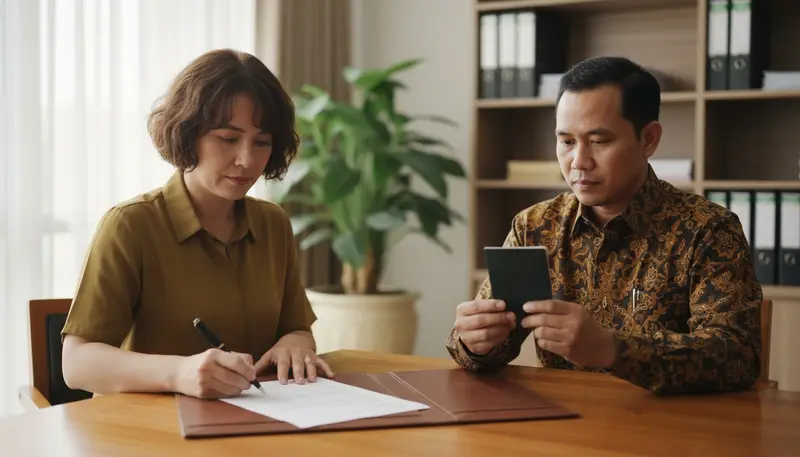
- Identity. Every signer shows an original passport or KTP. A company representative shows proof of authority.
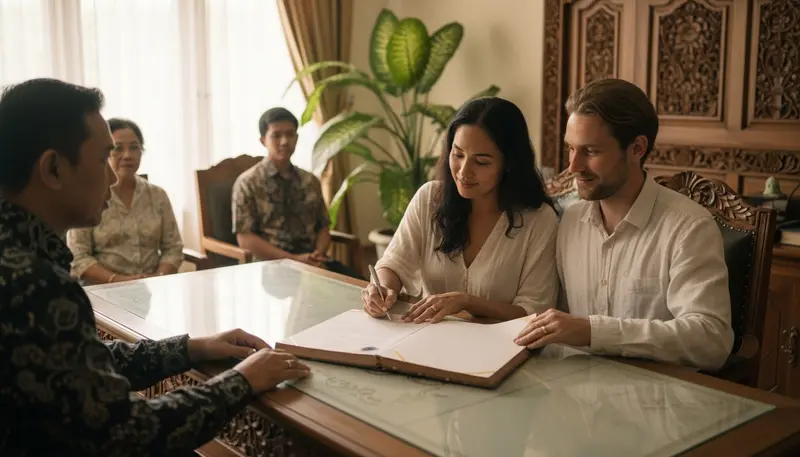
- Signing. You sign in the notary's presence.
- Certification. The notary signs and stamps the document.
- Use abroad, if needed. An apostille or legalisation follows.
Simple documents can often be done the same day, depending on the type. The notary can also come to you, see mobile notary in Bali: mobile visits at home, at your villa or at your office in Bali are available.
Which language must a notarized document be in?
Indonesian is the language of the law. An agreement with an Indonesian party must be in Bahasa Indonesia, with a version in English or your language, so bilingual documents are normal. The team explains every page in English before you sign. If you are asked to sign something you cannot read, ask for a translation first. A contract review helps when the content matters as much as the stamp.
What should I bring to the notary?
- Bring original identity documents, not copies.
- Make sure the document is complete and correctly drafted before the appointment.
- Allow time for translation if the document is not in Indonesian.
- If the document will be used outside Indonesia, ask about the apostille at the same time.
What is legalisasi and waarmerking?
Both are ways a notary deals with a private document (surat di bawah tangan) that the parties wrote themselves, under Article 15 of the Notary Law (Undang-Undang Jabatan Notaris):
| Act | What happens | What it proves |
|---|---|---|
| Legalisasi | The parties sign in front of the notary, who records the document in a special register | Who signed and on which date |
| Waarmerking | A document already signed is brought in and recorded in a special register | That the document existed on the registration date |
| Legalisir of a copy | The notary compares a photocopy with the original | That the copy matches the original |
None of these turns a private agreement into a notarial deed (akta notaris). A deed is drafted by the notary and carries full evidential weight in court. For a lease, a sale agreement or a power of attorney that a land office or bank will rely on, a deed is usually the safer form.
Do I need a sworn translator, and do you offer it?
Yes, we offer sworn translation (penerjemah tersumpah) as a service, between English and Indonesian. Indonesian offices usually want a foreign language document translated by a sworn translator before they rely on it, and documents going abroad may need one alongside the apostille or legalisation. Deeds that involve a foreigner are drafted in Indonesian and English side by side, so the deed itself does not need a separate translation. Send a photo of the document on WhatsApp and tell us which office will receive it; price and timing are quoted on request. See sworn translation in Bali.